
 Image 1 of 2
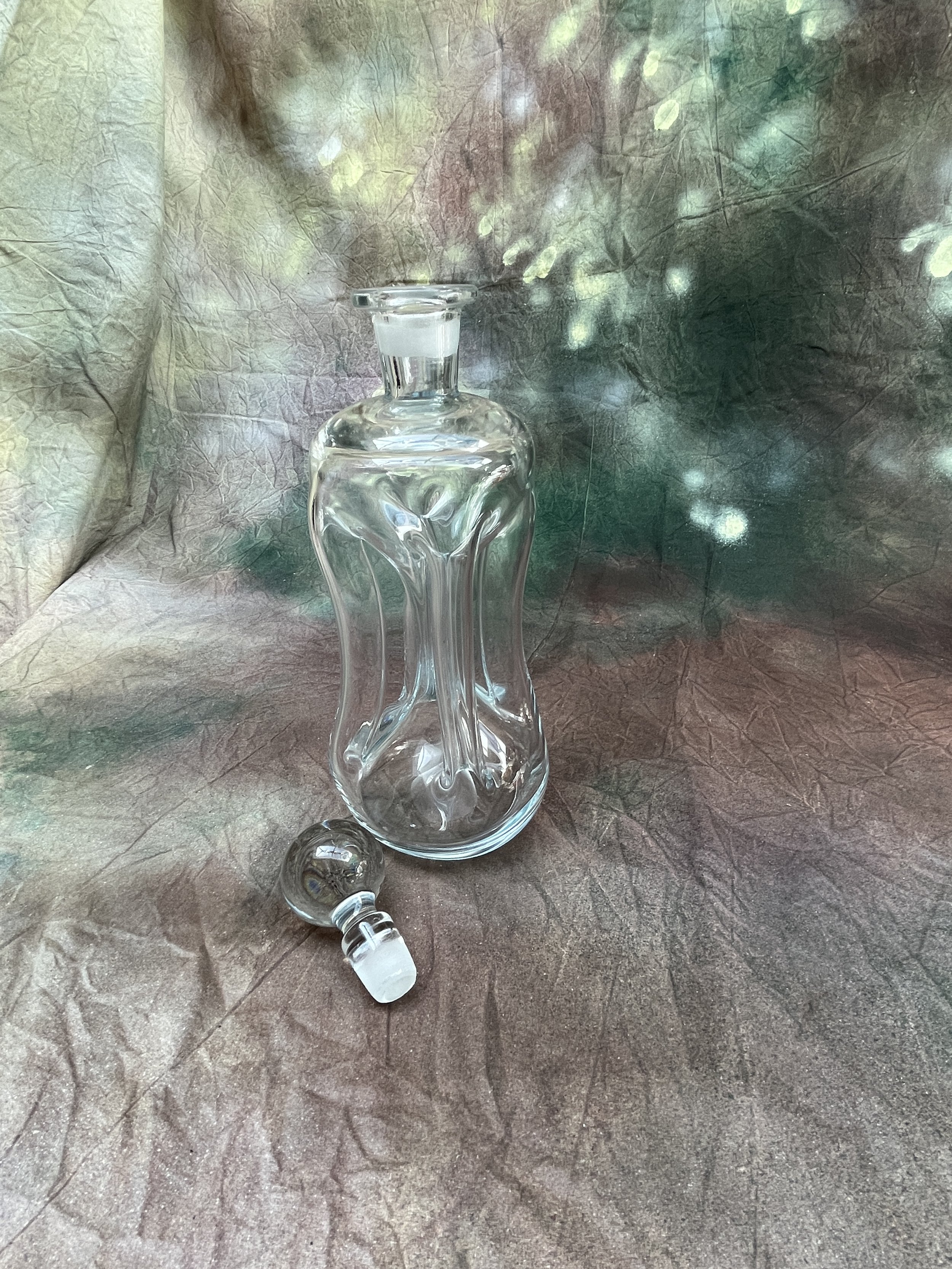 Image 2 of 2
Possibly Holmegaard, Mid‑20th Century
Height: approx. 5.75–6 in (to stopper)
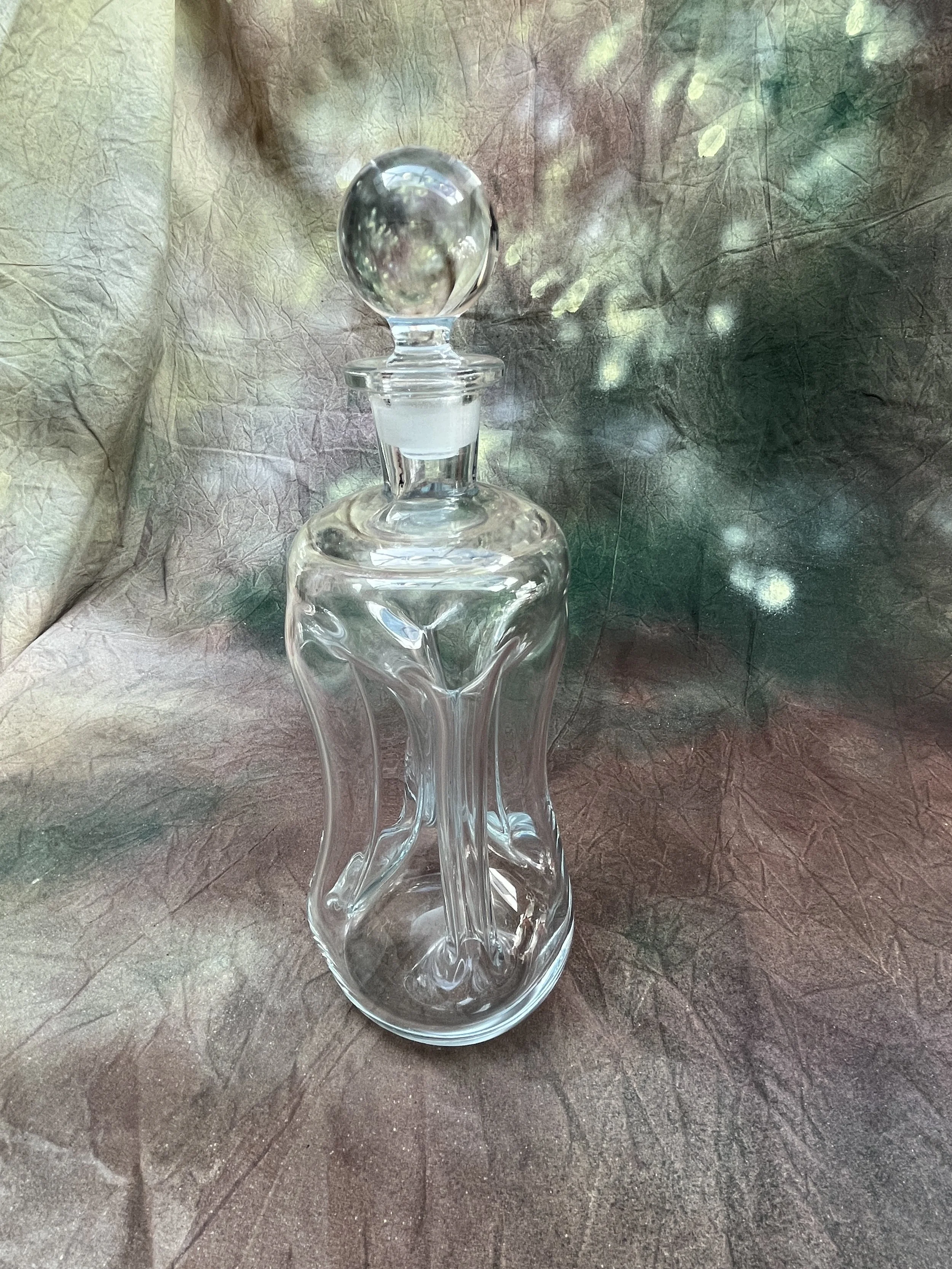
A finely blown miniature Scandinavian “Kluk Kluk” decanter, exhibiting the distinctive pinched waist and sculptural clarity associated with the classic Jacob E. Bang designs for Holmegaard. Though the maker is unknown, the form closely follows the mid‑century Scandinavian examples celebrated for their playful hydraulic behaviour, producing the characteristic kluk kluk or glug glug sound when poured.
This small‑scale version—among the smallest typically encountered—offers strong decorative presence despite its compact proportions, making it an appealing addition to a collection of Scandinavian glass or an elegant accent within a bar or drinks cabinet.
Holmegaard Glasværk and Jacob E. Bang
Holmegaard Glasværk is widely regarded as the cornerstone of Danish glassmaking. Among the country’s oldest glassworks, it has shaped the identity of Danish design through its long tradition of collaborating with leading artists and designers. One of the most influential of these was Jacob E. Bang.
Born in Frederiksberg in 1899 and originally trained as an architect, Bang joined Holmegaard in 1925 as a draftsman. By 1928 he had become artistic director, guiding the glassworks into a new era of modern design. He was one of the first Danish glass designers to gain international recognition, receiving awards at world exhibitions in Barcelona, Brussels, Paris and New York.
Bang is widely regarded as a pioneer of functionalism in Danish glass. His guiding principle—“beautiful, strong, appropriate and cheap”—aligned with Holmegaard’s own vision that every Dane should be privileged to have a Holmegaard glass. Although primarily an industrial designer, Bang played a decisive role in establishing Holmegaard as a true design house. His work balanced clarity of form with artistic expression, a quality particularly evident in series such as Opaline and Viol, which function as both utilitarian objects and sculptural pieces.
Today, Jacob E. Bang’s designs are considered style icons and remain highly sought after by collectors and glass enthusiasts worldwide.
Condition
Very good overall; minor variations consistent with hand‑blown production. Please refer to photographs for a full visual assessment.
Possibly Holmegaard, Mid‑20th Century
Height: approx. 5.75–6 in (to stopper)
A finely blown miniature Scandinavian “Kluk Kluk” decanter, exhibiting the distinctive pinched waist and sculptural clarity associated with the classic Jacob E. Bang designs for Holmegaard. Though the maker is unknown, the form closely follows the mid‑century Scandinavian examples celebrated for their playful hydraulic behaviour, producing the characteristic kluk kluk or glug glug sound when poured.
This small‑scale version—among the smallest typically encountered—offers strong decorative presence despite its compact proportions, making it an appealing addition to a collection of Scandinavian glass or an elegant accent within a bar or drinks cabinet.
Holmegaard Glasværk and Jacob E. Bang
Holmegaard Glasværk is widely regarded as the cornerstone of Danish glassmaking. Among the country’s oldest glassworks, it has shaped the identity of Danish design through its long tradition of collaborating with leading artists and designers. One of the most influential of these was Jacob E. Bang.
Born in Frederiksberg in 1899 and originally trained as an architect, Bang joined Holmegaard in 1925 as a draftsman. By 1928 he had become artistic director, guiding the glassworks into a new era of modern design. He was one of the first Danish glass designers to gain international recognition, receiving awards at world exhibitions in Barcelona, Brussels, Paris and New York.
Bang is widely regarded as a pioneer of functionalism in Danish glass. His guiding principle—“beautiful, strong, appropriate and cheap”—aligned with Holmegaard’s own vision that every Dane should be privileged to have a Holmegaard glass. Although primarily an industrial designer, Bang played a decisive role in establishing Holmegaard as a true design house. His work balanced clarity of form with artistic expression, a quality particularly evident in series such as Opaline and Viol, which function as both utilitarian objects and sculptural pieces.
Today, Jacob E. Bang’s designs are considered style icons and remain highly sought after by collectors and glass enthusiasts worldwide.
Condition
Very good overall; minor variations consistent with hand‑blown production. Please refer to photographs for a full visual assessment.